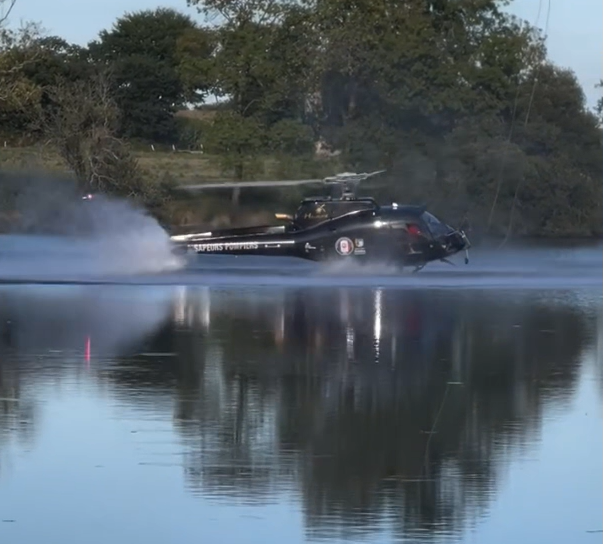
The firefighting helicopter accident in Rosporden, Brittany, may have been triggered less by dramatic piloting errors and more by the subtle limitations of avionics during low-altitude water operations.
When helicopters scoop water with a suspended bucket, they rely heavily on both visual cues and radio altimeter readings to maintain a safe hover just meters above the surface. Normally, modern radio altimeters provide auditory feedback—callouts or warning tones that alert the crew as they descend through preset altitudes. These alerts act as a final safeguard against inadvertently flying too low.
However, over calm water, the system itself can be misled. Smooth reflective surfaces often scatter or absorb radar energy, producing unstable or false readings. In such cases, the warning tone may trigger too late, or not at all; since instead of scattering the radio signal back directly, it can reflect the beam away or cause multiple reflections (a phenomenon called multipath). In practice, this means that the altimeter may either receive a delayed, distorted signal or no signal at all.
That leaves the crew reliant on visual judgment—also compromised by the “mirror illusion,” where water reflects the sky and creates a false impression of altitude.
The aircraft’s tail rotor may have struck the water, a failure mode consistent with either misjudged visual altitude or incorrect instrument feedback. With a short bucket line bringing the helicopter even closer to the surface, the margin for error was minimal. Once the tail rotor contacted the water, loss of control would have been nearly instantaneous. Adding to the complexity, many helicopters are equipped with Terrain Awareness and Warning Systems (TAWS or HTAWS). These are designed to prevent Controlled Flight Into Terrain by generating alerts when the aircraft approaches the ground at unsafe rates of descent. However, in firefighting profiles—where helicopters repeatedly dip to just above the surface—TAWS often becomes more of a nuisance than a help. Pilots sometimes reduce sensitivity or silence alerts to avoid constant alarms, effectively removing another safeguard during the most hazardous phase of flight.
The Rosporden crash underscores a persistent avionics vulnerability: while auditory low-altitude alerts are designed as lifesavers, their effectiveness can be undermined in the very scenarios where they matter most. Thank God, nobody was injured.
PS: Not every H125 has a radar altimeter as standard (as the Morane 29 was), but it’s a well-supported upgrade—and many operators specifically install one, especially for low-altitude operations like firefighting (at least one configuration includes the Thales AHV16 as part of its avionics suite).